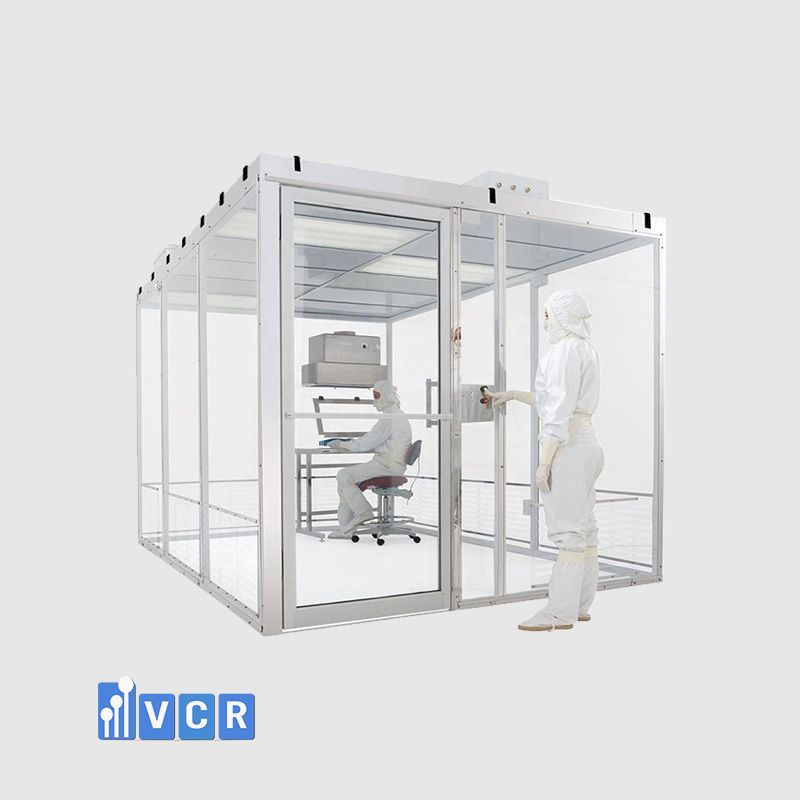
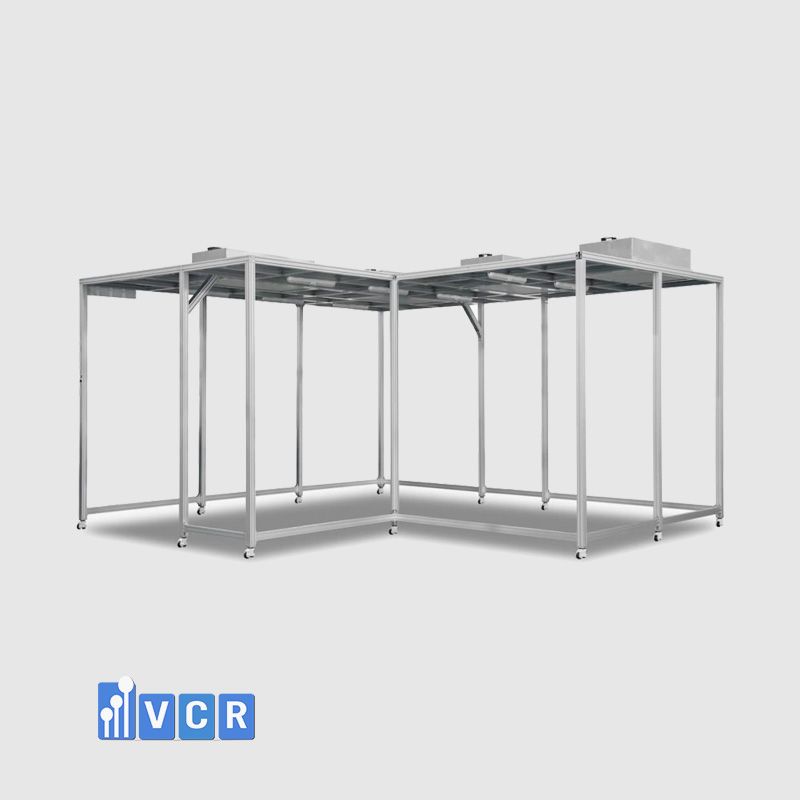
In real-world implementation, “VCR Cleanroom Equipment” has found that Clean Booth performance depends primarily on airflow design and overall airtightness, rather than just the use of HEPA filters or the number of FFUs.
What are the main components of a Clean Booth?
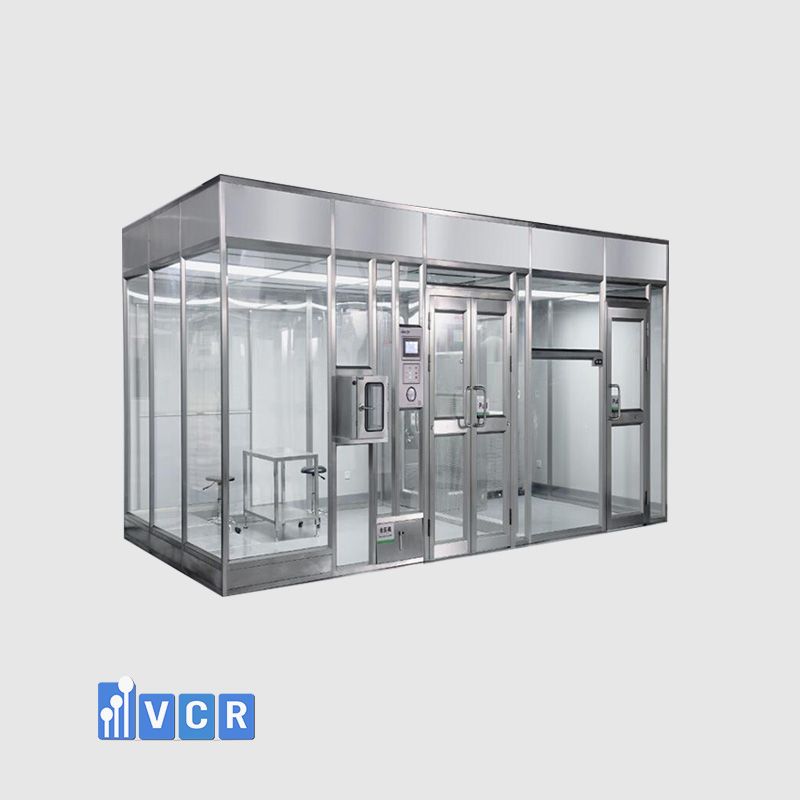
A Clean Booth consists of key components including the structural frame, air filtration system (FFU with HEPA/ULPA filters), enclosure panels, lighting system, and optional accessories such as sensors or monitoring devices. These components work together to create a controlled environment that meets required cleanliness levels.
In practice, the structure is not just a collection of parts but a fully integrated system. The positioning of FFUs, enclosure tightness, and structural dimensions directly affect airflow behavior and cleaning efficiency, making system-level design critical.
How is the Clean Booth frame designed to ensure stability and flexibility?
The Clean Booth frame is typically constructed from aluminum profiles or powder-coated steel to provide structural rigidity, load-bearing capacity, and durability in industrial environments. It is usually designed in a modular format for easy installation and expansion.
Beyond mechanical strength, the frame must support airflow distribution and equipment placement. A well-designed frame minimizes vibration, stabilizes FFUs, and ensures tight connections, improving overall system performance.
What does the filtration system in a Clean Booth include and how does it function?
The filtration system primarily includes FFUs equipped with HEPA or ULPA filters to remove fine particles from incoming air. This system is responsible for achieving the required cleanliness level.
The number and arrangement of FFUs are calculated to ensure sufficient airflow and uniform distribution. Poor design can result in dead zones or uneven airflow, reducing contamination control effectiveness.
What is the role of FFU in the overall Clean Booth design?
FFUs generate and maintain clean airflow by drawing in air, filtering it, and supplying it to the workspace, ensuring a stable clean environment.
In design terms, FFUs are not standalone devices but core elements that define airflow patterns. Incorrect placement or insufficient quantity can lead to imbalance and reduced performance.
How are enclosure panels selected for a Clean Booth?
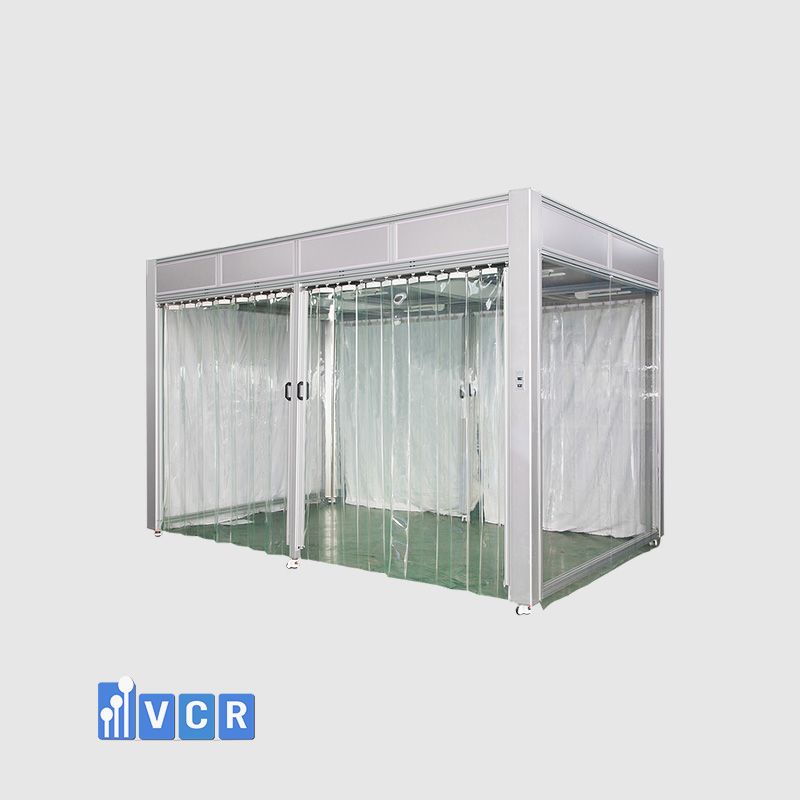
Enclosure panels are typically made from PVC curtains, polycarbonate sheets, or rigid panels depending on requirements for airtightness, durability, and visibility. Each material serves different application needs.
Material selection impacts not only cost but also operational performance. Flexible curtains offer ease of installation, while rigid panels provide better environmental control and structural integrity.
What are the common Clean Booth design types?
Clean Booths are commonly designed as open, semi-enclosed, or fully enclosed systems depending on contamination control requirements.
Open designs are suitable for basic dust control, while fully enclosed systems are used for higher cleanliness requirements. Choosing the correct design balances cost and performance.
What is the airflow principle in a Clean Booth and why is it critical?
Clean Booths use downward airflow to push particles away from the workspace and maintain a clean environment. This is a fundamental contamination control principle.
Airflow is the most critical factor in design because it determines how particles are removed. Poor airflow design compromises the entire system regardless of filtration quality.
Do Clean Booths use unidirectional airflow and when is it required?
Some Clean Booths are designed with unidirectional airflow to minimize turbulence and improve contamination control in critical applications.
This is typically required in high-sensitivity processes, although it increases complexity and cost compared to standard airflow systems.
Do Clean Booths require air return systems and how does this affect design?
Clean Booths typically do not include air return systems, instead exhausting air into the surrounding environment, simplifying system design and reducing costs.
However, this requires careful consideration to avoid disrupting surrounding airflow and ensure stable internal conditions.
Is integrated lighting required in Clean Booth design?
Clean Booths usually include integrated lighting to ensure adequate working conditions, especially in precision tasks.
Lighting design must avoid interfering with airflow or creating particle accumulation zones, requiring careful integration.
How can monitoring systems be integrated into a Clean Booth?
Clean Booths can integrate sensors for pressure differential, temperature, humidity, and particle count to monitor environmental conditions in real time.
Monitoring enhances control, supports GMP audits, and enables early detection of system deviations.
Can a Clean Booth integrate a Pass Box and what are the benefits?
A Clean Booth can integrate a Pass Box to transfer materials without disrupting the clean environment.
This reduces contamination risk and improves operational efficiency, particularly in controlled processes.
Can a Clean Booth integrate an Air Shower?
Clean Booths can be combined with Air Showers to control contamination from personnel entering the clean zone.
This integration improves overall cleanliness and reduces the burden on internal filtration systems.
Is airtightness important in Clean Booth design and why?
Airtightness is essential to prevent leakage and maintain proper airflow performance within the Clean Booth.
Poor sealing allows unfiltered air to enter, reducing system effectiveness and compromising cleanliness levels.
Is pressure control required in Clean Booths and how is it achieved?
Clean Booths typically use positive pressure to prevent contaminated air from entering the clean zone.
This pressure is generated by FFU airflow and must be properly balanced for stable operation.
Can Clean Booths be customized for specific requirements?
Clean Booths can be customized in size, cleanliness level, and configuration to meet specific project requirements.
Customization ensures suitability across different industries and applications.
Is airflow calculation necessary in Clean Booth design and how is it done?
Airflow must be calculated based on volume, cleanliness requirements, and FFU capacity to ensure sufficient air supply.
Incorrect calculations can lead to poor performance or unnecessary energy consumption.
Can Clean Booths be designed as modular systems and what are the advantages?
Modular design allows Clean Booths to be easily installed, expanded, or reconfigured as needed.
This flexibility is critical for facilities with changing production layouts.
Can multiple filtration stages be used in a Clean Booth?
Clean Booths can include multiple filtration stages such as pre-filters and HEPA filters to improve efficiency and extend filter life.
This approach reduces load on HEPA filters and optimizes operational cost.
How should a Clean Booth be designed for optimal long-term performance?
An optimal design requires integration of structure, filtration, airflow, airtightness, and pressure control to maintain a stable environment.
A well-designed system ensures long-term performance, cost efficiency, and compliance with ISO and GMP throughout its lifecycle.
Duong VCR